

Table of Contents
Picking the perfect pen isn’t as simple as grabbing the first thing off the shelf. Whether you’re a seasoned pen enthusiast or someone who just wants a reliable writing experience, understanding the differences between fountain pens, ballpoint pens, and rollerball pens can save you money, frustration, and a whole lot of smudged paper. In this in-depth guide, we’ll break down how each pen type works, what makes them unique, and — most importantly — which one deserves a spot in your pocket. So grab your favourite drink, settle in, and let’s talk pens to find the one that’s truly right for you.
How Do Fountain Pens Work? Understanding the Heart of the Fountain Pen
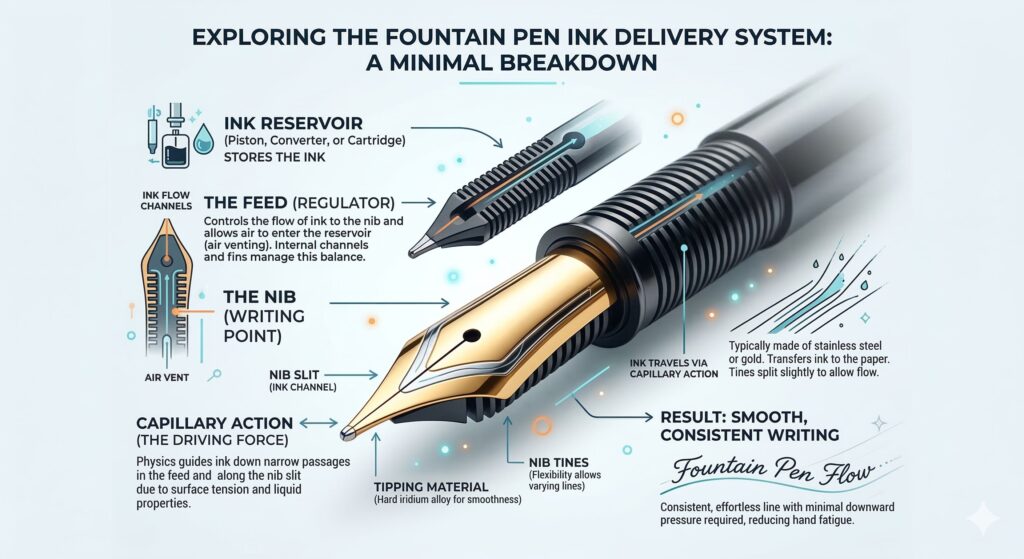
If you’ve ever watched someone glide a fountain pen across a page and thought, “That looks borderline magical,” you’re not entirely wrong. At the heart of the fountain pen lies a beautifully simple mechanism: a way to draw ink down the reservoir. nib, a feed, and an ink reservoir working in harmony. The fountain pen uses a nib — typically made from stainless steel or gold — that splits into two tines. When you press the nib against paper, those tines separate ever so slightly, allowing ink to flow through capillary action. There’s no clicking, no spring-loaded mechanism — just physics doing what physics does best. The fountain pen ink travels from the reservoir (either a built-in piston, a converter, or an ink cartridge) down through the feed, which regulates ink flow to ensure you get a steady, consistent line. It’s this gravity-and-capillary system that gives fountain pens their famously smooth flow of a fountain pen on paper. Unlike their ballpoint cousins, fountain pens work without requiring much downward force, which means your hand stays relaxed even during long writing sessions. Many fountain pens today — especially modern fountain pens — have refined this system to the point where they’re remarkably low-maintenance. That said, the nib remains the soul of the instrument. A fine fountain pen nib produces crisp, thin lines perfect for detailed note-taking, while a broad nib lays down thick, expressive strokes ideal for calligraphy or signatures. The nib width, material, and flexibility all contribute to a unique writing style that’s genuinely personal. In essence, the modern fountain pen is centuries-old technology perfected for the 21st century — and once you understand how it works, you’ll appreciate why so many writers swear by them.
What Is a Ballpoint Pen and How Does It Differ?
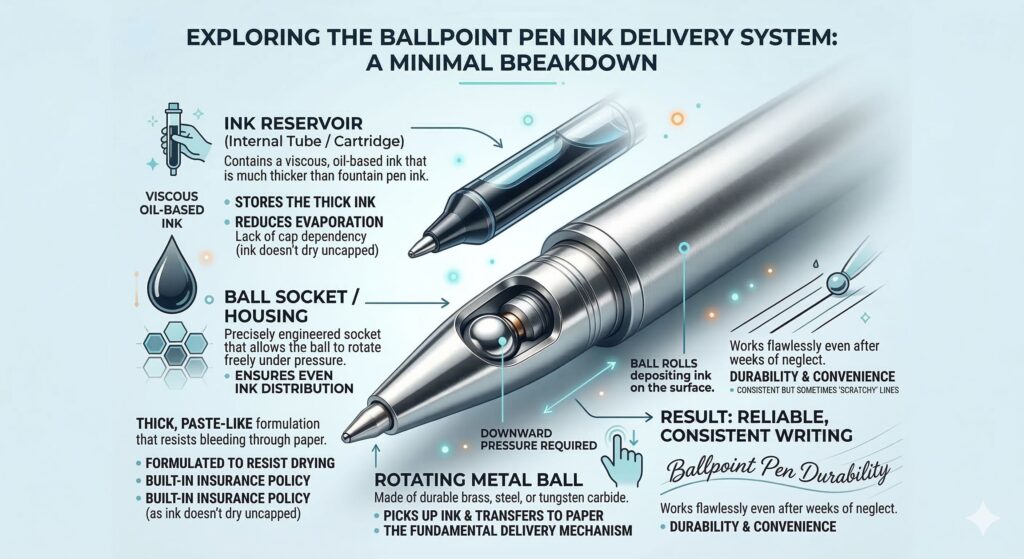
Let’s be honest: the ballpoint pen is the workhorse of the pen world. It’s in your junk drawer, your office supply cabinet, and probably stuck behind your ear right now. But don’t let its ubiquity fool you — the ballpoint is a marvel of engineering in its own right. The fundamental difference between a ballpoint and a fountain pen lies in the delivery mechanism. Instead of a nib, a ballpoint pen features a tiny rotating metal ball — usually made of brass, steel, or tungsten carbide — seated at the head of the pen. As you write, this ball rolls across the paper, picking up thick, paste-like oil-based ink from the internal reservoir and depositing it on the surface. The ink in ballpoint pens is specifically formulated to be viscous, which is why it doesn’t bleed through paper or dry out when left uncapped. In fact, ballpoint pens use this thicker ink as a kind of built-in insurance policy: you don’t need to worry about capping the pen or babysitting it to use to prevent the ink from evaporating. This makes the disposable ballpoint incredibly convenient for everyday writing — toss it in your bag, forget about it for a week, and it’ll still work flawlessly when you need it. However, this convenience comes with a trade-off. Because the ink is so thick, a ballpoint needs more downward pressure to get the ball rolling (literally), which can lead to hand fatigue during extended writing sessions. Some people find that a ballpoint pen will deliver consistent but somewhat “scratchy” lines compared to the buttery smoothness of a fountain pen. Still, for reliability, portability, and sheer value for money, the ballpoint is tough to beat — and it’s the reason billions of them are sold every single year worldwide.
What Is a Rollerball Pen? Where Does It Fit In?
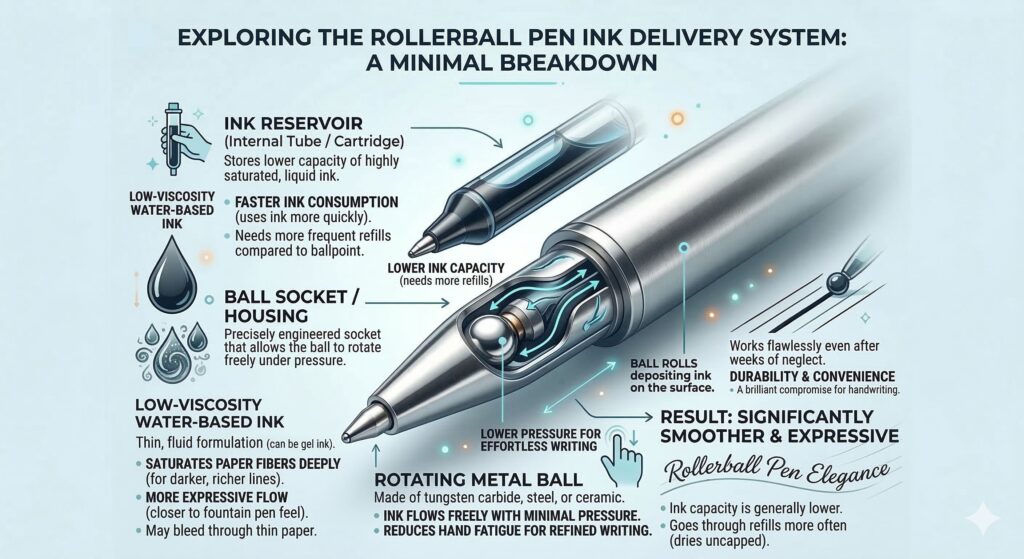
If the fountain pen is the artist and the ballpoint is the pragmatist, then the rollerball pen is the diplomat that pens bridge the gap between the two. A rollerball uses the same ball-and-socket delivery system as a ballpoint, but here’s the twist: instead of oil-based paste, rollerball pens use a water-based ink (or sometimes gel ink). This liquid ink flows far more freely than its ballpoint counterpart, which means you get a writing experience that’s significantly smoother and more expressive — closer to a fountain pen’s elegance without the learning curve. The lower viscosity of rollerball ink means you don’t need to apply much pressure on the pen to produce clean, vivid lines. This makes rollerball pens a favourite among people who want the smoothness of a fountain pen but the convenience of a click-and-write instrument. You’ll also notice that rollerball pens vs ballpoints tend to produce darker, more saturated lines because the ink saturates paper fibres more deeply. However, the same properties that make rollerball ink so pleasant to write with also introduce some drawbacks. Because the ink is thinner and more fluid, it tends to run out faster — the ink capacity of a rollerball is generally lower than a ballpoint’s. The ink can also bleed through thinner paper, and if you leave the cap off, the ink may dry out. If you want to opt for a rollerball pen, just keep in mind that you’ll likely go through refills more often. That said, for signatures, personal letters, and any situation where the look and feel of your handwriting matter, the rollerball is a brilliant compromise.
Fountain Pen vs Ballpoint: What Are the Key Differences Between Fountain Pens and Ballpoints?
The debate of fountain pen vs ballpoint is practically a rite of passage for anyone who cares about their writing tools. Let’s cut through the noise and lay out the differences between fountain pens and ballpoints in a clear, side-by-side comparison. At the most fundamental level, a fountain pen delivers ink through a nib via capillary action, while a ballpoint pushes viscous oil-based ink past a rotating ball. This single mechanical difference ripples outward into nearly every aspect of the writing experience: smoothness, line quality, maintenance, cost, and even hand health.
Here’s a quick comparison table to make things crystal clear:
| Feature | Fountain Pen | Ballpoint Pen |
|---|---|---|
| Ink Type | Water-based or dye-based fountain pen ink | Thick, oil-based ink |
| Delivery | Nib (capillary action) | Rotating ball |
| Pressure Needed | Very light | Moderate to firm |
| Line Quality | Rich, variable, expressive | Consistent, thin, uniform |
| Ink Drying | Slower (risk of smudging) | Quick-drying ink, minimal smudging |
| Maintenance | Fountain pens require regular cleaning | Almost none |
| Ink Options | Hundreds of ink colors | Limited (mostly blue, black, red) |
| Cost | Higher upfront; lower long-term | Cheap upfront; disposable |
| Best For | Extended writing, calligraphy, journaling | Quick notes, forms, everyday writing |
The fountain pen vs ballpoint argument ultimately comes down to priorities. Fountain pens offer a luxurious, low-pressure writing experience with incredible ink variety, but fountain pens require cleaning, careful storage, and a bit of patience. Ballpoint pens vs fountain pens are virtually maintenance-free and work in nearly any condition — upside down, on carbon paper, even in space (well, sort of). If you value expression and craft, the fountain pen wins. If you value reliability and zero fuss, the ballpoint is your ally. And honestly? Most pen enthusiasts end up owning both.
Rollerball vs Ballpoint vs Fountain Pen: Which Writing Experience Wins?
Now for the million-dollar question — or, more accurately, the £15-to-£500 question. When it comes to the overall writing experience, how does a rollerball vs ballpoint vs fountain pen stack up? Let’s talk feel first. Using a fountain pen is like driving a vintage sports car: smooth, responsive, and deeply satisfying. The nib glides across paper with minimal effort, and the ink flow creates lines that vary in width depending on your angle and pressure. There’s an almost meditative quality to it. A ballpoint, by contrast, is like a reliable SUV — it gets the job done without drama. The ink dries almost instantly, making it ideal for left-handed writers or anyone who’s tired of smudging. A rollerball splits the difference: smoother than a ballpoint, more convenient than a fountain pen. Fountain pens use a liquid-based ink that saturates paper beautifully, while pens use a liquid-based ink in rollerballs too, though the delivery mechanism differs. In practice, if you’re writing a long letter, journaling, or practising calligraphy, the fountain pen might be your best companion — the effortless ink flow keeps your hand relaxed and your lines consistent. For quick notes in a meeting or filling out forms, using ballpoint pens is the pragmatic choice because the fast-drying ink won’t smear under your palm. And if you want something that looks and feels premium without the ritual of maintaining a fountain pen, a rollerball or ballpoint pen in the mid-price range will serve you beautifully. Real-world example: many lawyers and doctors still prefer ballpoints for medical forms and legal documents because the ink on paper is much more resistant to water damage and fading. Meanwhile, writers and artists gravitate toward fountain pens for their expressiveness. The rollerball? It’s the pen you reach for when you want your handwriting to actually look good on a birthday card.
How Does Ink Type Affect Your Pen Choice? Fountain Pen Ink vs Oil-Based Ink
Ink is the unsung hero of the pen world, and the type of pen you choose essentially determines what ink technology you’re committing to. Fountain pen ink is typically water-based or dye-based, which gives it that gorgeous, saturated colour and effortless flow. The downside? It takes longer to dry, which means smudging is a real risk — especially for left-handers. You’ll also need to prevent the ink from drying inside the pen by capping it properly and flushing the system periodically. Some writers use water-based ink specifically for the richness it brings to the page, and with hundreds of available ink colors, the customization possibilities are genuinely staggering. On the other end of the spectrum, ballpoint pens rely on oil-based ink — a thick, paste-like formula designed for practicality. This ink won’t bleed through paper, dries almost instantly, and resists water. The trade-off is that your colour options are limited, and the lines tend to look thinner and less vibrant. Rollerball pens use a middle-ground approach: their water-based ink or gel ink flows more freely than a ballpoint’s paste but is still housed in a convenient, capped or retractable body. It’s worth noting that ink without proper storage can become problematic regardless of pen type. Ink drying in the pen is a common complaint among fountain pen users who forget to cap their pens, but modern solutions like quick-seal caps and quick-drying ink formulations have made this less of an issue. If ink versatility and colour are your priorities, choose a fountain pen and explore brands like GoldSpot Pens (yes, goldspot pens — they’re a well-known retailer) for an enormous selection. If you just need something that works every time without thinking about it, a ballpoint with oil-based ink is the way to go.
Nib Types and Their Impact: How Does a Fountain Pen Nib Change Everything?
The nib is arguably the most important component of any fountain pen, and understanding nib types can transform your entire writing experience. A fountain pen nib typically comes in sizes ranging from extra-fine (EF) to broad (B), with specialty options like stub, italic, and flex nibs for the adventurous. An extra-fine nib lays down razor-thin lines — perfect for small handwriting or detailed note-taking. A medium nib offers a sweet spot between control and expressiveness, while a broad nib produces thick, calligraphic strokes that make writing feel almost theatrical. The material matters too: stainless steel nibs are durable and affordable, while gold nibs (14k or 18k) offer a softer, springier feel that many pen enthusiasts consider the gold standard — pun very much intended. The fountain pen’s nib also affects ink flow directly. A wetter nib release more ink onto the paper, creating richer lines but increasing drying time. A drier nib conserves ink and reduces smudging but may feel scratchier. Some many fountain pens allow you to swap nibs entirely, which means you can customise one pen body for multiple writing styles. Now, here’s something that often surprises newcomers: a ballpoint has no nib at all. Its ball-and-socket mechanism is standardised, which means one ballpoint writes pretty much like any other (with minor variations in ball size and ink formula). Similarly, a rollerball uses a ball tip rather than a nib. This means that if customization and fine-tuning your writing style are important to you, a fountain pen is the only game in town. The nib is where a fountain pen becomes truly personal — it’s the interface between your hand and the page, and choosing the right one can make the difference between “meh” and “magnificent.”
Ink Capacity and Maintenance: What Does Each Pen Type Require?
Let’s talk about the less glamorous side of pen ownership: ink capacity and upkeep. Fountain pens require regular maintenance to stay in top shape. At minimum, you should flush your fountain pen with water every few weeks — especially if you switch ink colors frequently. The ink cartridge or converter system needs to be replaced or refilled periodically, and if you leave a fountain pen unused for too long, the ink drying in the pen can clog the feed. That said, pens require less effort than you might think once you establish a routine. A quick rinse every two to four weeks takes about five minutes. On the flip side, ballpoint pens are essentially zero-maintenance. The sealed ink reservoir and viscous formula mean you can ignore a ballpoint for months and it’ll still write. The trade-off? When a ballpoint runs out of ink, you typically throw it away (unless you’re using a refillable model). The ink capacity of a standard ballpoint refill is actually quite impressive — some can write for over two kilometres of continuous line. Rollerball pens fall somewhere in between. Their thinner ink means they run out faster than ballpoints — sometimes two to three times faster — but refills are widely available. Pens provide different value propositions here: a fountain pen with a bottled ink supply is the most economical long-term option (a single bottle of ink can last months), while a disposable ballpoint is the cheapest upfront but adds up over time.
Here’s a quick maintenance comparison:
| Maintenance Task | Fountain Pen | Ballpoint | Rollerball |
|---|---|---|---|
| Cleaning frequency | Every 2-4 weeks | Never | Rarely |
| Refill method | Ink cartridge, converter, or piston fill | Replace refill or pen | Replace refill |
| Cap required? | Yes (to prevent the ink from drying) | No (retractable or cap) | Yes (usually) |
| Average ink capacity | 0.5-1.5 ml per fill | 0.3-0.5 ml per refill (but lasts longer) | 0.5-0.7 ml per refill |
| Long-term cost | Low (bottled ink is cheap) | Medium (disposable adds up) | Medium |
Ballpoint and Fountain Pen Price Comparison: Which Pen Is Worth Your Money?
Money talks, so let’s break down the economics of ballpoint and fountain pen ownership. A decent ballpoint pen can cost anywhere from £0.20 for a basic disposable to £200+ for a luxury model from brands like Montblanc or Parker. The sweet spot for a quality ballpoint refillable pen is around £15-£40. Ink refills cost £2-£5 each and last a long time thanks to that viscous oil-based ink. If you’re using a fountain pen, the upfront cost is higher — a solid entry-level fountain pen from brands like Lamy, TWSBI, or Pilot runs £20-£60. Premium models can easily exceed £500. However, here’s where the economics get interesting: a 50ml bottle of fountain pen ink costs around £8-£15 and can fill a pen 50+ times. Over a year of daily writing, a fountain pen user might spend less on ink than a ballpoint user spends on disposables. Rollerball pens sit in the middle. Entry-level models cost £10-£30, with refills priced at £3-£8 each. Because rollerball ink runs out faster, annual refill costs can be comparable to or even higher than those of a ballpoint. For pen enthusiasts who view pens as collectible writing instruments, the fountain pen offers the best long-term value and the most satisfying ownership experience. For practical, budget-conscious writers, a quality refillable ballpoint is the most cost-effective option. And for those who want a premium feel without the fountain pen learning curve, the rollerball is a worthy investment.
Can You Use a Fountain Pen for Everyday Writing? Practical Tips and Considerations
A common myth is that fountain pens are too delicate or high-maintenance for daily use. Nonsense. Using a fountain pen for everyday writing is not only possible — it’s genuinely enjoyable. The key is choosing the right setup. Start with a modern fountain pen that has a snap-on or screw cap to prevent drying, and pair it with a fast-drying ink if you’re worried about smudging. Brands like Pilot Vanishing Point even offer retractable fountain pens for ultimate convenience. Here are some practical tips for daily fountain pen use. First, pick a nib size that matches your handwriting — if you write small, go extra-fine; if you have a looser style, a medium nib works beautifully. Second, keep your pen inked. A fountain pen that’s used daily actually stays healthier than one that sits idle, because regular ink flow prevents the feed from clogging. Third, invest in decent paper. Fountain pen ink behaves best on paper that’s at least 80gsm — cheap copier paper will feather and bleed. Real-world example: many professionals in Japan and Germany use fountain pens as their primary writing instrument at work. It’s not just a hobby — it’s a daily tool. If you’re currently a ballpoint user curious about switching, try carrying both for a week. Use the fountain pen for journaling or note-taking and the ballpoint for quick signatures and forms. You’ll quickly discover which contexts each pen makes the most sense for. The choice between a fountain pen and a ballpoint for daily use isn’t binary — it’s contextual, and the smartest approach is usually to have both at your disposal.
Choosing the Right Pen: How to Pick the Perfect Pen for Your Needs
So, how do you go about choosing the right pen? The perfect pen depends on your writing habits, preferences, and what you value most in a writing instrument. Here’s a simple decision framework. Ask yourself these questions: How much do I write daily? Do I care about line quality and aesthetics? Am I willing to do basic maintenance? What’s my budget? If you write a lot and enjoy the process, a fountain pen is probably your ideal match — the low pressure on the pen reduces fatigue, and the ink flow makes long sessions pleasurable. If you need a grab-and-go pen that works anywhere without fuss, a ballpoint is the obvious right pen. If you want the best of both worlds, a rollerball is the smart compromise.
Here’s a quick decision guide:
| If You… | Choose a… |
|---|---|
| Write for extended periods | Fountain pen |
| Need a reliable, low-maintenance pen | Ballpoint pen |
| Want smooth lines without fountain pen upkeep | Rollerball pen |
| Love customizing ink colors and nib sizes | Fountain pen |
| Write on cheap or thin paper often | Ballpoint pen |
| Sign documents frequently | Rollerball or ballpoint |
| Collect pens as a hobby | Fountain pen (definitely) |
The difference between a fountain pen, ballpoint, and rollerball ultimately comes down to your pen depends on your writing goals. Don’t overthink it — the best pen is the one you actually enjoy using. And remember, there’s no rule that says you can only own one. Many writers keep a fountain pen or rollerball for personal writing and a trusty ballpoint or fountain backup for quick tasks. The pen world is wonderfully diverse, so explore, experiment, and find what makes your handwriting sing.
Conclusion: Fountain Pen, Ballpoint, or Rollerball — Which Pen Type Is Right for You?
We’ve covered a lot of ground — from nib anatomy to ink chemistry to real-world usage scenarios. Here’s a bullet-point summary of the most important takeaways:
- Fountain pens deliver the smoothest, most expressive writing experience but require regular cleaning and careful storage.
- Ballpoint pens are the most reliable and maintenance-free option, ideal for everyday writing and practical tasks.
- Rollerball pens offer a middle ground — smoother than ballpoints, more convenient than fountain pens.
- Ink type matters: fountain pens use water-based ink for rich colour; ballpoints use oil-based ink for durability; rollerballs use water-based or gel ink for smooth flow.
- The nib is what makes a fountain pen truly personal — different sizes and materials dramatically affect your line quality.
- Long-term, fountain pens are often more economical thanks to cheap bottled ink, while ballpoints win on upfront affordability.
- Rollerball or fountain — either is a great upgrade from a basic disposable ballpoint if you want to elevate your handwriting.
- There’s no single “best” pen — the right pen depends on your needs, habits, and personal taste.
- Like a ballpoint for convenience but crave smoother lines? Start with a rollerball. Want the full experience? Go fountain.
Whatever you choose, the simple act of picking a quality writing instrument shows you care about the words you put on paper. And that’s never a bad thing.
FAQs
Is a fountain pen better than a ballpoint pen for everyday use?
It depends on your definition of “better.” A fountain pen offers a smoother, more comfortable writing experience with less hand fatigue, making it excellent for extended writing sessions like journaling or note-taking. However, a ballpoint pen is more practical for quick tasks — it doesn’t require capping, the ink dries instantly, and it works on virtually any paper type. If you’re willing to invest a few minutes per month in maintenance, a fountain pen can absolutely serve as a daily driver. Many people find that once they switch, they never want to go back.
What’s the main difference between a rollerball and a ballpoint pen?
The biggest difference between a ballpoint and a rollerball pen is the ink they use. Ballpoint pens use oil-based ink that’s thick and paste-like, requiring more pressure to write but drying almost instantly. Rollerball pens use thinner, water-based ink that flows more freely, producing darker and smoother lines. The trade-off is that rollerball ink runs out faster and can bleed through thin paper. Think of it this way: a ballpoint prioritizes durability, while a rollerball prioritizes writing quality.
Can I use fountain pen ink in a rollerball pen?
Generally, no — and you really shouldn’t try. Fountain pen ink and rollerball ink are formulated differently, and using the wrong type can damage the pen’s internal mechanism. Fountain pen ink is designed to flow through a nib and feed system via capillary action, while rollerball ink is engineered for a ball-tip mechanism. Mixing these can lead to clogging, leaking, or inconsistent ink flow. Always use the ink or refill type recommended by your pen type‘s manufacturer.
Are expensive fountain pens worth the investment?
For casual writers, a £25-£40 entry-level fountain pen from brands like Lamy Safari or Pilot Metropolitan will deliver an excellent writing experience without breaking the bank. However, premium fountain pens (£100+) often feature superior nib craftsmanship — particularly gold nibs, which are smoother and more responsive than steel. They also tend to have better build quality, more refined filling systems, and greater aesthetic appeal. If you write daily and appreciate fine craftsmanship, a premium fountain pen is genuinely worth it. If you’re just curious, start affordable and upgrade once you know what you like.
0 Comments